

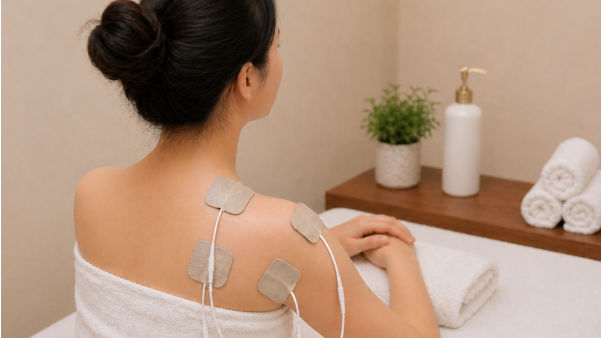
Frequency specific microcurrent (FSM) is an electrotherapy modality that some physical therapists use as an adjunct alongside therapeutic exercise and manual therapy. The published evidence is still early. Even so, a retrospective rehabilitation study, a recent pilot randomized controlled trial, and several registered trials now give clinicians enough to judge where the modality may fit in a plan of care and where caution is still warranted.
How FSM Differs From Other Electrotherapy
FSM delivers current in the microamp range, which is a small fraction of the output used by many other electrical stimulation devices. A case report in a medical acupuncture journal describes it as an adjustable microcurrent modality with applications for pain and associated symptoms. The report also notes a practical distinction from TENS: FSM is generally subsensory and is not intended to produce muscle contraction.
The modality is built around frequency pairings delivered across two channels. One channel’s frequency is selected for the condition being addressed and the other for the target tissue. These pairings are organized into protocols that set the sequence of frequencies, current levels, and timings for a session. Treatment is applied through electrode pads or leads placed around the treatment area while the patient rests, so it can run concurrently with other parts of a visit.
Device parameters determine what a clinician can actually deliver. MEND Technology, a manufacturer whose Professional unit was designed by FSM practitioners, builds its microcurrent devices for clinical FSM practice to these specifications:
- two fully independent output channels and a constant current generator
- a programmable frequency range of 0.1 to 999.9 Hz
- current intensity from 20 to 400 microamps
- square-pulse output at a 50 percent duty cycle
- polarity that can be set to alternating, positive, or negative
What the Evidence Shows for Rehabilitation Patients
The study most relevant to outpatient rehabilitation is a 2020 retrospective case-control study. It compared 213 patients who received FSM alongside physical rehabilitation with 78 control patients who received rehabilitation alone, across mechanical low back pain and neck pain. Outcomes included the numerical pain rating scale, the Oswestry Disability Index, and the Neck Disability Index.
In the low back pain group, patients receiving FSM had significantly lower post-treatment pain scores. A higher proportion of them also reached a pain score of three or below, the minimal disability category, and the full success category. In the neck pain group, the researchers found no significant difference in pain, disability, or treatment outcome between groups. They concluded that FSM could be a useful adjunct in rehabilitation for low back pain specifically.
A 2025 pilot randomized controlled trial examined adults with clinically significant stress. Of 85 participants assessed at baseline, 58 were randomized across four groups: FSM alone, FSM with relaxation, relaxation alone, and relaxation with placebo. After six sessions, participants receiving FSM reported fewer somatic symptoms and negative emotions than the relaxation group. The finding is relevant for patients whose recovery is complicated by stress-related physical complaints, although it comes from a small pilot.
A 2019 case series also described three wounded service members treated with FSM alongside acupuncture, whose pain and associated symptoms improved more quickly with the combined approach. The authors highlighted that FSM can be delivered concurrently with other treatments, which is useful when appointment time is limited.
Limitations Clinicians Should Weigh
The current evidence supports cautious interest more than firm conclusions. The low back pain study was retrospective, so treatment allocation was not randomized and selection effects cannot be ruled out. The stress trial was a pilot, the relaxation-only group also improved significantly within groups, and the authors called for a definitive trial. The case series authors acknowledged that clinical research on FSM remains limited.
Several registered trials are now testing FSM under more controlled conditions. These include a sham-controlled study of inflammatory markers in osteoarthritis and a triple-masked randomized trial on symptoms after concussion. Their results should help clarify which presentations respond and which protocols produce consistent outcomes.
For now, the evidence supports positioning FSM as an adjunct within an established plan of care. Clinicians who introduce it can track response with the same standardized measures used in the published work, such as pain rating scales and disability indexes. This keeps their own outcome data comparable with the literature.
Choosing an FSM Machine for Clinical Use
Device selection usually depends on how a clinic plans to use the modality. Therapists who write their own protocols need adequate memory and the ability to adjust polarity, waveform, frequency, intensity, and time during a session. A keypad for direct frequency entry and the option to daisy-chain several protocols are also practical features to compare. MEND’s Professional unit, for example, holds up to 999 practitioner-written protocols and supports manual, automated, and programmable operation in one device.
Clinicians who are newer to FSM may prefer a unit that arrives preloaded with established protocols, as a starting point while they build familiarity with frequency pairings. MEND’s Wellness unit, which comes loaded with a library of Physical Medicine protocols, is one example of that approach. Portability and battery power also matter for clinics that treat across several rooms or sites. Therapists can compare professional and wellness microcurrent unit specifications to see how memory capacity, channel independence, and programming options differ between models.
MEND Technology
6715 NE 63rd St
Ste 103 PMB 120
Vancouver
Washington
98661
United States
